

The leveraged investment portfolio can provide excellent investment returns to investors during periods of low volatility and economic expansion. Examples of liquid leveraged ETFs are TQQQ, SPXL, and TBT. These ETFs combined strategically in a portfolio can help investors outperform the market and reduce risk. We will explore how to build an investment portfolio using TQQQ, SPXL, and TBT ETFs.
What is a Leveraged ETF?
A leveraged ETF is an exchange-traded fund that uses leverage to achieve a higher return than would be possible with a traditional, unleveraged ETF like Nasdaq ETF QQQ or SP500 ETF SPY. Leveraged ETFs are designed to provide investors with exposure to an underlying asset or index while magnifying the returns.
For example, suppose we wanted to invest in an ETF that tracks the Nasdaq 100 index. We could purchase unleveraged ETF QQQ, which would give us exposure to the underlying index.
We could also purchase a leveraged ETF that aims to provide 2x or 3X the return of the Nasdaq 100 index before fees and expenses. This means that if the index goes up by 10%, your ETF would aim to provide a return of 20% or 30%. Conversely, if the index goes down by 10%, your ETF would seek to provide a negative return of 20% or 30%.
What is an Inverse ETF?
Inverse ETFs are a type of investment that can be used to hedge against market declines or to profit from downward price movements. While these funds can offer some advantages, there are also some potential drawbacks to consider before investing.
One key benefit of inverse ETFs is that they protect your portfolio from market downturns. Owning an inverse fund can offset losses in your other investments and help minimize your overall risk. Additionally, these funds can provide the opportunity to profit from falling prices.
Because these funds are designed to perform well when prices decline, they will often underperform in rising markets. The market will go up more than goes down. Therefore, inverse ETFs must be used as hedges.
How do Leveraged ETFs Provide These High Returns?
Leveraged ETFs such as TQQQ, SPXL, and TBT ETFs work by using derivatives and debt to achieve a higher level of return. The way that this works is that the fund will take on debt and interest in more shares of the underlying asset.
This will then increase the number of shares that the fund owns and, as a result, the value of the fund. The use of leverage can help to magnify the gains that are made from the underlying asset, but it can also magnify the losses.
Leveraged Investment Strategies
Several different strategies can be employed when investing in leveraged ETFs. Here are some of the strategies:
Portfolio volatility: Combine a few different leveraged ETFs, which allows investors to get exposure to a variety of different asset classes and indexes. This strategy will help investors minimize portfolio risk during periods of volatility such as rising rates which will have a serious impact on the equities market.
Dollar Cost Average Investment: It is better to invest periodically instead of in lump sums into void serious drawdowns. It will be hard for investors to diversify systematic risk.
Liquid Portfolio: ItPortfolioTFs must have decent volume.
Cover Call Option Strategy: This strategy can be used to make money in a variety of ways. The most common way is to buy shares of leveraged ETFs and then sell call options against those ETFs.Even If the ETF price goes up, the leveraged portfolio will provide an extra return on the appreciation in the leveraged ETF price. If the ETF price goes down, the portfolio return will still increase due to the premiums received from selling the call options.
Popular Leveraged and Inverse ETFs List
TQQQ ETF :ProShares UltraPro QQQ (3x) ETF
SQQQ ETF :ProShares UltraPro Short QQQ (3x) ETF
SOXL ETF :Direxion Semiconductor Bull (3x) ETF
SH ETF :ProShares Short S&P 500 ETF
QLD ETF: ProShares Ultra QQQ ETF
SSO ETF: ProShares Ultra S&P500 ETF
SPXL ETF: Direxion Large Cap Bull 3x Shares ETF
UPRO ETF :ProShares UltraPro S&P 500 (3x) ETF
SPXU ETF :Direxion Daily Large Cap Bear (3x) ETF
UCO ETF :Ultra Bloomberg Crude Oil (2x) ETF
SOXS ETF :Direxion Daily Semiconductor Bear (3x) ETF
QID ETF :ProShares UltraShort (2x) QQQ ETF
UDOW ETF: UltraPro Dow30 (3x) ETF
TMF ETF: Direxion Daily 30-Yr Treasury Bull 3x Shrs ETF
ERX ETF: Direxion Daily Energy Bull 2x Shares ETF
SCO ETF :UltraShort (2x) DJ-UBS Crude Oil ETF
FAS ETF :Direxion Financial Bull 3x Shares ETF
PSQ ETF :ProShares Short QQQ ETF
TECL ETF :Direxion Technology Sector (3x) ETF
LABU ETF :Direxion Daily S&P Biotech Bull 3X ETF
TBT ETF: ProShares UltraShort 20+ Year Treasury (2x) ETF
SPXU ETF: ProShares UltraPro Short S&P500 ETF
TNA ETF : Direxion Daily Small Cap Bull (3x) ETF
SDS ETF :UltraShort (2x) S&P 500 ETF
SPXL ETF: SPXL is an ETF that seeks to provide 3x the daily return of the S&P 500 Index. The ETF is managed by Direxion and is one of the many leveraged ETFs on the market.SPXL is one of the popular choices for investors looking for a leveraged ETF because it tracks the widely followed S&P 500 Index.
TQQQ ETF: The TQQQ ETF is a leveraged exchange-traded fund that tracks the NASDAQ-100 Index. The fund provides investors with exposure to the 100 largest non-financial companies listed on the Nasdaq Stock Market. TQQQ has outperformed the broader market in recent years. TQQQ is underperforming the market this year because of the rising rate environment due to inflation.
TBT ETF: The TBT ETF offers investors a way to hedge their portfolios against rising interest rates. The TBT ETF provides inverse exposure to the treasury market. TBT ETF has a strong correlation with bond yield. TBT ETF will rise in value as treasury prices fall.
Leveraged ETF Risk
The objectives of these leveraged ETFs are for daily returns therefore, investors willing to hold these ETFs for more than one day can face a risk of significant loss of capital if the portfolio is not hedged properly, especially during periods of high market volatility.
Before investing in a leveraged ETF, investors need to understand how a leveraged ETF works and what the risks are.
| Symbol | Type | Beta |
| TQQQ | 3X Leveraged ETF | 3.51 |
| SQQQ | 3X Inverse ETF | -2.43 |
| SOXL | 3X Leveraged ETF | 3.83 |
| SH | 1X Inverse ETF | -0.9 |
| QLD | 2X Leveraged ETF | 2.27 |
| SSO | 2X Leveraged ETF | 2.06 |
| SPXL | 3X Leveraged ETF | 3.15 |
| UPRO | 3X Leveraged ETF | 3.15 |
| FAS | 3X Leveraged ETF | 3.22 |
| PSQ | 1X Inverse ETF | -0.98 |
| TECL | 3X Leveraged ETF | 3.56 |
| LABU | 3X Leveraged ETF | 2.87 |
| TBT | 2X Inverse ETF | -4.37 |
| SPXU | 2X Inverse ETF | -2.36 |
| TNA | 3X Leveraged ETF | 3.36 |
| SDS | 2X Inverse ETF | -1.69 |
| SPXS | 3X Inverse ETF | -2.36 |
| UCO | 2X Leveraged ETF | 3.94 |
| SOXS | 3X Inverse ETF | -2.79 |
| QID | 2X Inverse ETF | -1.84 |
| UDOW | 3X Leveraged ETF | 2.9 |
| RWM | 1X Inverse ETF | -1.05 |
| TBF | 1X Inverse ETF | -2.17 |
| TZA | 3X Inverse ETF | -2.75 |
| ERX | 2X Leveraged ETF | 3.06 |
| SCO | 2X Inverse ETF | -4.28 |
| SPDN | 1X Inverse ETF | -0.9 |
| KOLD | 2X Inverse ETF | -3.32 |
| NUGT | 2X Leveraged ETF | 2.88 |
| SDOW | 3X Inverse ETF | -2.1 |
| TMF | 3X Leveraged ETF | 6.52 |
| SVXY | 1X Inverse ETF | -2.34 |
| DOG | 1X Inverse ETF | -0.82 |
| BOIL | 2X Leveraged ETF | 3.81 |
| JNUG | 2X Leveraged ETF | 3.75 |
| TECS | 3X Inverse ETF | -2.47 |
| SRTY | 3X Inverse ETF | -2.62 |
| TWM | 2X Inverse ETF | -1.98 |
| FAZ | 3X Inverse ETF | -2.55 |
| LABD | 3X Inverse ETF | -1.98 |
| YANG | 3X Inverse ETF | -0.2 |
| DRIP | 3X Inverse ETF | -1.61 |
| JDST | 2X Inverse ETF | -1.33 |
| DUST | 2X Inverse ETF | -0.98 |
| ERY | 2X Inverse ETF | -2.49 |
Leveraged Portfolio Example: Asset Allocation
Asset allocation should be based on the risk tolerance of each investor. Past performance is not always indicative of future investment results.
Investment Portfolio Allocation: We are going to craft a portfolio with 60% of equity and 40% of fixed income. We will also allocate 40% of the equity to TQQQ ETF and 60% to SPXL ETF.
Dollar Cost Average Investment: We will invest constantly at the beginning of each month based on the above portfolio allocation.
Summary of Investment Portfolio Strategies
TQQQ ETF: 24% of the monthly investment
SPXL ETF: 36% of the monthly investment
TBT ETF: 40% of the monthly investment
2022 Investment Portfolio Performance
This example is based on a $100 investment each month from the beginning of the year 2022 into our leveraged ETFs portfolio. We will compare our strategy to other popular non-leveraged ETFs such as VTI ETF, SPY ETF, and QQQ ETF.
Before we get into the portfolio performance, let us explore what these popular non-leveraged ETFs are.
VTI ETF: The Vanguard Total Stock Market ETF (VTI) is an exchange-traded fund that aims to track the performance of the total US stock market.VTI is a low-cost and diversified way to gain exposure to the US stock market. In nutshell, If you’re looking for a way to invest in the U.S. stock market, then the Vanguard Total Stock Market ETF could be a good option for you.
SPY ETF: The SPY ETF is one of the most popular exchange-traded funds on the market. SPY tracks the S&P 500 Index and is the largest ETF by assets. The fund is highly liquid and has a very low expense ratio. SPY ETFs are a great way to get exposure to US’s largest cap stocks. They offer diversification and can be a great way to start investing.
QQQ ETF: QQQ ETFs are a popular type of ETF that tracks the performance of the NASDAQ-100 Index, which comprises the 100 largest non-financial companies. QQQ ETFs offer investors exposure to a broad range of industries and sectors, including technology, healthcare, consumer discretionary, and more.
Data Disclosure: Data used for the analysis is pulled from Yahoo Finance.
Adjusted close price adjusted for splits and dividend and/or capital gain distributions.
ProShares UltraPro QQQ (TQQQ)
| Date | Close | Amount $ | Shares |
| Sep 16, 2022 | 24.6 | ||
| Sep 01, 2022 | 24.6 | 24 | 0.98 |
| Aug 01, 2022 | 27.81 | 24 | 0.86 |
| Jul 01, 2022 | 33.36 | 24 | 0.72 |
| Jun 01, 2022 | 24 | 24 | 1.00 |
| May 01, 2022 | 33.05 | 24 | 0.73 |
| Apr 01, 2022 | 36.53 | 24 | 0.66 |
| Mar 01, 2022 | 58.18 | 24 | 0.41 |
| Feb 01, 2022 | 52.46 | 24 | 0.46 |
| Jan 01, 2022 | 61.83 | 24 | 0.39 |
| 216 | 6.20 |
Year-to-date investment for the TQQQ ETF is a loss of 29% of capital invested in our portfolio as of September 16, 2022. Based on our monthly investment of $100, TQQQ ETF is allocated $24 (24% of monthly investment and 40% of the equity portfolio)
Direxion Daily S&P 500 Bull 3X Shares (SPXL)
| Date | Close | Amount $ | Shares |
| Sep 16, 2022 | 67.97 | ||
| Sep 01, 2022 | 67.97 | 36 | 0.53 |
| Aug 01, 2022 | 73.22 | 36 | 0.49 |
| Jul 01, 2022 | 84.47 | 36 | 0.43 |
| Jun 01, 2022 | 65.51 | 36 | 0.55 |
| May 01, 2022 | 87.34 | 36 | 0.41 |
| Apr 01, 2022 | 89.23 | 36 | 0.40 |
| Mar 01, 2022 | 119.66 | 36 | 0.30 |
| Feb 01, 2022 | 108.65 | 36 | 0.33 |
| Jan 01, 2022 | 120.6 | 36 | 0.30 |
| 324 | 3.74 |
Year-to-date investment for the SPY ETF is a loss of 21% of capital invested in our portfolio as of September 16, 2022. Based on our monthly investment of $100, SPY ETF is allocated $36 (36% of monthly investment and 60% of the equity portfolio)
ProShares UltraShort 20+ Year Treasury (TBT)
| Date | Close | Amount $ | Shares |
| Sep 16, 2022 | 29.35 | ||
| Sep 01, 2022 | 29.35 | 40 | 1.36 |
| Aug 01, 2022 | 26.99 | 40 | 1.48 |
| Jul 01, 2022 | 24.75 | 40 | 1.62 |
| Jun 01, 2022 | 26.15 | 40 | 1.53 |
| May 01, 2022 | 25.65 | 40 | 1.56 |
| Apr 01, 2022 | 24.84 | 40 | 1.61 |
| Mar 01, 2022 | 20.48 | 40 | 1.95 |
| Feb 01, 2022 | 18.6 | 40 | 2.15 |
| Jan 01, 2022 | 18.15 | 40 | 2.20 |
| 360 | 15.47 |
Year-to-date investment for the TBT ETF is a gain of 26% of capital invested in our portfolio as of September 16, 2022. Based on our monthly investment of $100, TBT ETF is allocated $40 (40% of monthly investment and 100% of the fixed income portfolio)
SPDR S&P 500 ETF Trust (SPY)
| Date | Close | Amount $ | Shares |
| Sep 16, 2022 | 385.56 | ||
| Sep 01, 2022 | 383.98 | 100 | 0.26 |
| Aug 01, 2022 | 393.56 | 100 | 0.25 |
| Jul 01, 2022 | 410.3 | 100 | 0.24 |
| Jun 01, 2022 | 374.09 | 100 | 0.27 |
| May 01, 2022 | 409.47 | 100 | 0.24 |
| Apr 01, 2022 | 408.55 | 100 | 0.24 |
| Mar 01, 2022 | 446.47 | 100 | 0.22 |
| Feb 01, 2022 | 431.63 | 100 | 0.23 |
| Jan 01, 2022 | 444.76 | 100 | 0.22 |
| 900 | 2.20 |
Year-to-date investment for the SPY ETF is a loss of 6% of capital invested in our portfolio as of September 16, 2022. Based on our monthly investment of $100, SPY ETF is allocated $100.
Invesco QQQ Trust (QQQ)
| Date | Adj Close | Investment $ | Shares |
| Sep 16, 2022 | 289.32 | ||
| Sep 01, 2022 | 289.32 | 100 | 0.35 |
| Aug 01, 2022 | 299.27 | 100 | 0.33 |
| Jul 01, 2022 | 315.46 | 100 | 0.32 |
| Jun 01, 2022 | 279.74 | 100 | 0.36 |
| May 01, 2022 | 307.69 | 100 | 0.33 |
| Apr 01, 2022 | 312.65 | 100 | 0.32 |
| Mar 01, 2022 | 361.4 | 100 | 0.28 |
| Feb 01, 2022 | 345.71 | 100 | 0.29 |
| Jan 01, 2022 | 361.91 | 100 | 0.28 |
| 900 | 2.84 |
Year-to-date investment for the QQQ ETF is a loss of 9% of capital invested in our portfolio as of September 16, 2022. Based on our monthly investment of $100, QQQ ETF is allocated $100.
Vanguard Total Stock Market Index Fund (VTI)
| Date | Close | Amount $ | Shares |
| Sep 16, 2022 | 194.63 | ||
| Sep 01, 2022 | 194.63 | 100 | 0.51 |
| Aug 01, 2022 | 198.56 | 100 | 0.50 |
| Jul 01, 2022 | 206.25 | 100 | 0.48 |
| Jun 01, 2022 | 187.87 | 100 | 0.53 |
| May 01, 2022 | 205.54 | 100 | 0.49 |
| Apr 01, 2022 | 206.06 | 100 | 0.49 |
| Mar 01, 2022 | 226.06 | 100 | 0.44 |
| Feb 01, 2022 | 219.6 | 100 | 0.46 |
| Jan 01, 2022 | 225.2 | 100 | 0.44 |
| 900 | 4.35 |
Year-to-date investment for the VTI ETF is a loss of 6% of capital invested in our portfolio as of September 16, 2022. Based on our monthly investment of $100, VTI ETF is allocated $100.
Leveraged ETFs Strategies compared to Non-Leveraged ETFs
| Asset | Type | Allocation % | Return % | Investment $ | Balance $ |
| TQQQ ETF | Leveraged ETF | 24 | -29 | 216 | 153 |
| SPXL ETF | Leveraged ETF | 36 | -21 | 324 | 256 |
| TBT ETF | Inverse ETF | 40 | 26 | 360 | 454 |
| Portfolio | 100 | -4 | 900 | 863 | |
| SPY ETF | Non-Leveraged ETF | 100 | -6 | 900 | 846 |
| QQQ ETF | Non-Leveraged ETF | 100 | -9 | 900 | 819 |
| VTI ETF | Non-Leveraged ETF | 100 | -6 | 900 | 846 |
Leveraged ETFs are risky but combined strategically together in a diverse portfolio can reduce risk. Every investor should have Warren Buffett’s rules in mind.
Rule Number One: Never Lose Money.
Rule Number Two: Never Forget Rule Number One.
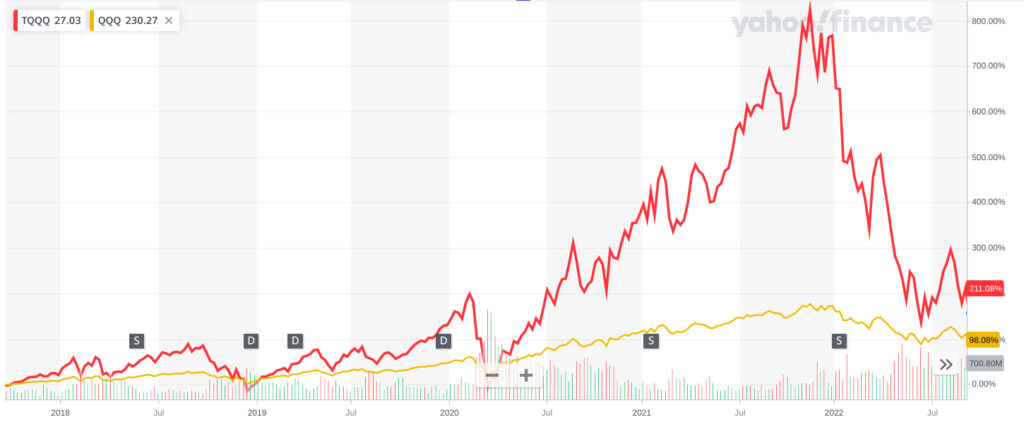
Leveraged ETFs will often outperform non-leveraged ETFs during periods of low volatility. Please see the TQQQ ETF chart compared to QQQ ETF during the last five years. Investors need to craft a portfolio that can protect and minimize the risk of capital loss during periods of high volatility and systematic risk.
Key Takeaways from investing in leveraged ETFs
1. Leveraged ETFs investments are very risky, especially during periods of high volatility. Investors can lose their entire capital if the underlying indexes happen to fall at least 33%.
2. Investors using leveraged ETFs in their portfolio must learn to take a profit at least once a year.
3. Leveraged ETF is a very useful portfolio management tool for growing a small account if used strategically.
4. Leverage ETF works better during periods of low market volatility.
5. Leveraged ETF uses financial derivatives therefore, their expenses and fees are often significantly higher than the ETFs tracking the underlying indexes
6. Stay diversified. Don’t put all your eggs in one basket. Leveraged ETFs should be used in the context of portfolio diversification.
7. Dollar Cost averages your investment monthly. Using a lump sum investment can be detrimental to your portfolio during downtrends.
8. Stay small. Don’t invest the biggest portion of your capital into leveraged ETFs for long-term
9. Without risk, there is no reward. If you are a long-term investor with at least a 10 years time horizon, adding a small portion of your investment into leveraged ETFs strategically is not a bad idea at all.